EVALUACION FINAL DE MECANOGRAFIA:
Ingresar al LINK.
https://agilefingers.com/es/textos
Realizar los ejercicios
1 al 6
EVALUACION FINAL DE MECANOGRAFIA:
Ingresar al LINK.
https://agilefingers.com/es/textos
Realizar los ejercicios
1 al 6Ingresar al blog y resolver
https://agilefingers.com/es/textos/alarcon-pedro-antonio-el-nino-de-la-bola-es
PRESENTAR A SU PROFESOR
A computer is a programmable electronic device that receives, stores, and processes data to generate useful information. It works using integrated circuits and is composed of physical parts (hardware) and programs (software). Computers are versatile tools that have transformed the way we work, communicate, and entertain ourselves, allowing us to do everything from writing documents and browsing the internet to editing videos and creating spreadsheets.
What is it and how does it work?
Electronic device:
It is a machine that manipulates information and data through a series of commands.
Data processing:
It receives input data, processes it, and converts it into useful information, which is then sent to output units.
Integrated circuits:
Its operation is based on electronic circuits that allow logical and arithmetic operations to be performed.
Main parts
1. Hardware:
These are the physical components that can be seen and touched.
CPU (Central Processing Unit): This is the "brain" of the computer, responsible for performing calculations and controlling the execution of operations.
Memory: Temporarily stores the information needed to run programs (RAM) or permanently stores it (ROM).
Input devices: Keyboard and mouse, which allow information to be entered into the system.
Output devices: Monitor, which displays the processed information.
2. Software:
These are the instructions or programs that tell the computer what to do.
Operating systems: These control the general operation of the hardware and manage the execution of other programs.
Applications: Specific programs for performing tasks such as writing, browsing the internet, or playing games.
Uses and applications:
Computers are very versatile tools and are used in various areas:
Work: Creating documents, spreadsheets, and presentations.
Communication: Sending emails, messaging, and video calls.
Entertainment: Web browsing, gaming, and playing music and videos.
Education: Searching for information and completing academic tasks.
Realizar la leccion cuantas veces le permita el tiempo disponible:
La hormiga y la paloma
Una hormiga bebía agua en un río, con tan mala suerte que cayó al agua. Pasaba por ahí una paloma que, al oír sus gritos de auxilio, corrió a salvar a la pequeña hormiga.
—Gracias, amiga paloma —dijo la hormiga muy agradecida—. Si algún día estás en peligro, yo te ayudaré.
Varias semanas después, un cazador vio a la paloma sobre una rama. Estaba a punto de disparar su escopeta cuando, de pronto, la hormiga se metió por debajo del pantalón y le mordió la pierna. Y así pudo la paloma escapar, sana y salva.
In a serene village, nestled between rolling green hills, lived a young baker named Elara. She was known for her kindness and the delicious bread she baked, which was as warm and comforting as her smile. But Elara's true passion was for the night sky. Every evening, after the last loaf was sold, she would climb to the highest hill and gaze at the constellations, each one a silent story waiting to be told.
One night, as a silvery moon cast its gentle light upon the land, a mischievous star fell from the heavens. It landed softly in Elara's garden, shimmering with a light that was both bright and playful. Elara, surprised but not frightened, approached the tiny star. It pulsed with a quiet energy, and in her mind, she heard a whisper, "Help me find my way back home."
Elara knew she couldn't simply pick up the star and toss it into the sky. It needed a guide, a true beacon of light. So, she took a piece of her dough, a little of her flour, and a pinch of her love, and she began to bake. She shaped the dough into a beautiful, crescent moon and placed the little star inside. As the bread baked, the star's light grew brighter, and the bread began to glow.
When it was finished, the bread was a radiant, golden orb. Elara carried it to the highest point of the hill, and with a silent prayer, she tossed it into the night sky. The glowing bread sailed through the darkness, and as it reached the heavens, the little star leaped out and rejoined its family, shining more brightly than ever before. The villagers, seeing the spectacular light, marveled at the new, brilliant constellation, a crescent moon with a single, shining star inside. And so, Elara taught everyone that a little kindness and a lot of heart can help even the smallest star find its way home.
EJERCICIO:
Realizar el texto en ingles y español cuantas veces le premita su tiempo.

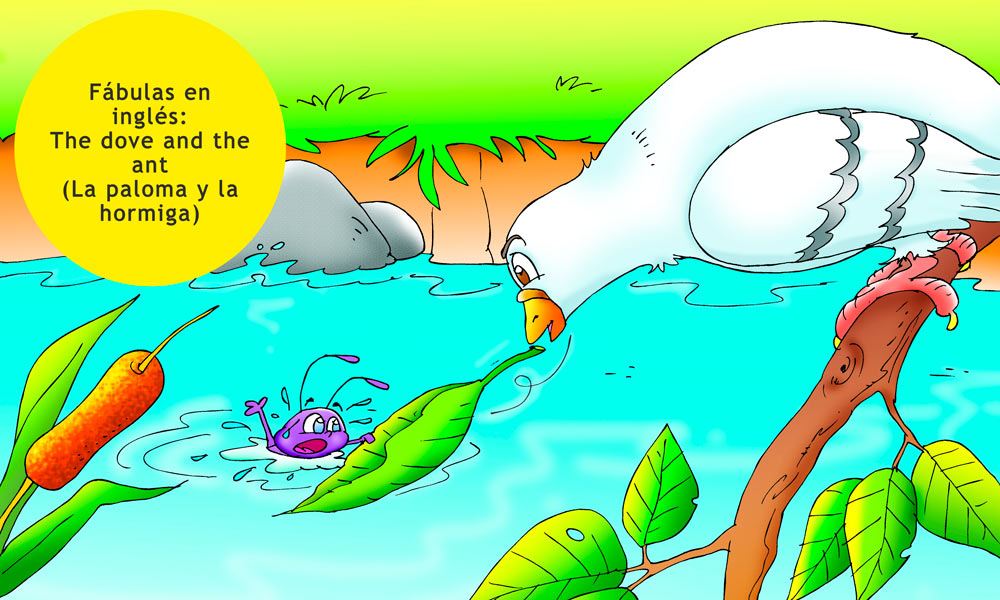
A dove saw an ant fall into a brook. The Ant struggled in vain to reach the bank, and in pity, the dove dropped a blade of straw close beside it. Clinging to the straw like a shipwrecked sailor to a broken spar, the Ant floated safely to shore.
Soon after, the ant saw a man getting ready to kill the dove with a stone. But just as he cast the stone, the ant stung him in the heel, so that the pain made him miss his aim, and the startled dove flew to safety in a distant wood.
Moral of the fable: a kindness is never wasted.
Fábula en español: La paloma y la hormiga
Una paloma vio una hormiga caer en un arroyo. La hormiga luchó en vano por llegar a la orilla y, compadecida, la paloma dejó caer una brizna de paja junto a ella. Aferrada a la paja como un marinero naufragado en un mástil roto, la hormiga flotó a salvo a la orilla.
Poco después, la hormiga vio a un hombre preparándose para matar a la paloma con una piedra. Pero justo cuando arrojó la piedra, la hormiga lo picó en el talón, de modo que el dolor le hizo perder su puntería, y la paloma sobresaltada voló a un lugar seguro en un bosque lejano.
Moraleja: la bondad nunca se desperdicia.